Hurricane Season Starts Tomorrow. The World Cup Starts in 15 Days. Nobody Is Talking About What Happens If They Collide.
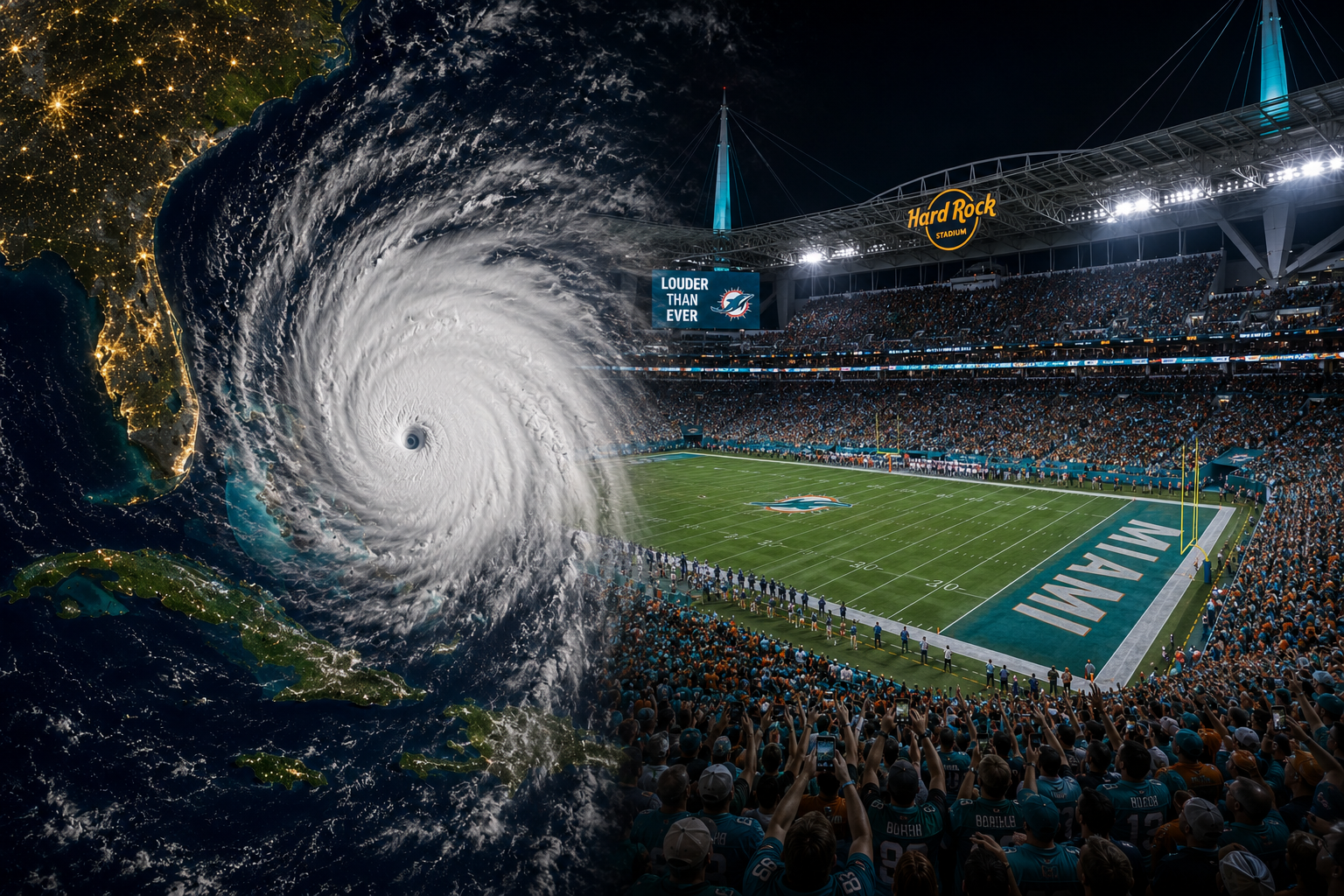
Hurricane season: June 1 through November 30. The World Cup at Hard Rock Stadium: June 15 through July 18. The overlap is total.
Hurricane season starts tomorrow. The World Cup starts in 15 days. The two biggest events of the summer in Miami Gardens overlap completely, and as far as we can tell, nobody is publicly addressing what happens if they collide.
NOAA released its official forecast this week: 8 to 14 named storms, 3 to 6 hurricanes, 1 to 3 major hurricanes. They give a 55% chance of a below-average season, largely because a strong (possibly "super") El Nino pattern is expected to suppress storm formation by late summer. Colorado State projects 13 named storms, 6 hurricanes, 2 major. Both forecasts point to a quieter-than-normal season.
That's encouraging. It also doesn't answer the question: what is the plan if a tropical system threatens South Florida while 65,000 fans are inside Hard Rock Stadium, 30,000 more are at the Fan Festival in Bayfront Park, and 600,000 international visitors are scattered across Miami-Dade County Airbnbs and hotel rooms?
We went looking for answers. Here's what we found, what we didn't, and what you should know regardless.
The timeline overlap
| World Cup Miami Match | Date | Hurricane Season Status |
|---|---|---|
| Saudi Arabia vs. Uruguay | June 15 | Day 15 of season |
| Uruguay vs. Cape Verde | June 21 | Day 21 |
| Scotland vs. Brazil | June 24 | Day 24 |
| Colombia vs. Portugal | June 27 | Day 27 |
| Round of 32 | July 3 | Day 33 |
| Quarterfinal | July 11 | Day 41 |
| Bronze Final | July 18 | Day 48 |
Every single match at Hard Rock Stadium falls within hurricane season. The group-stage matches (June 15-27) land in the earliest weeks when tropical development is less common but not impossible. The knockout rounds (July 3-18) push into the window when Caribbean tropical waves become more active.
For context: the 2005 season produced Tropical Storm Arlene on June 9 and Hurricane Dennis (Category 4) by July 7. The 2020 season's first named storm, Arthur, formed on May 16, two weeks before the season officially started. Early-season storms are unusual but they happen, and when they do, they tend to form in the Gulf of Mexico or western Caribbean and move quickly, giving less warning time than mid-season Atlantic storms.
The National Hurricane Center's current outlook is clear for now: no tropical cyclone formation is expected in the next 7 days. That takes us through June 6. Beyond that, nobody can predict.
What we know about contingency plans
South Florida's Local Emergency Planning Committee conducted a large-scale emergency response training exercise in Fort Lauderdale this week specifically tied to World Cup preparedness. The drill tested multi-agency coordination for mass-gathering scenarios, though details about specific weather contingencies haven't been made public.
Miami-Dade County's Emergency Management Division has experience with stadium-scale events during hurricane season. The Dolphins play eight home games between September and January, all within the season window. The Grand Prix in May sits just before the official start date but overlaps with the early threat period. The county has protocols for event cancellation, venue evacuation, and shelter activation.
What's less clear is how those protocols scale to a World Cup scenario:
Standard NFL protocol: If severe weather threatens a Dolphins game, the team and league can postpone by hours or days. Fans drive home. The visiting team flies out. Everyone has a local support network. The decision chain is simple: NFL, team, county.
World Cup protocol: FIFA, the Miami Host Committee, the U.S. Soccer Federation, Miami-Dade Emergency Management, the City of Miami Gardens, the State of Florida, and potentially FEMA all have roles. The decision to postpone or relocate a World Cup match involves international broadcasting contracts worth billions, travel logistics for 48 national teams, and diplomatic considerations that don't exist in a regular NFL game. The decision chain is not simple.
FIFA's official policy allows matches to be postponed, suspended, or relocated due to force majeure, which includes severe weather. But the operational details of how that plays out during a live tournament with simultaneous matches across three countries have not been publicly detailed for the Miami venue.
The 600,000 visitors who've never seen a hurricane
This is the part that concerns emergency planners most. During a typical hurricane threat, Miami-Dade County assumes its 2.7 million residents know the basics: board up, stock supplies, know your evacuation zone, have a plan. Most long-term residents have been through at least one major storm or extended watch. The institutional memory exists.
During the World Cup, the county adds roughly 600,000 visitors, many of whom:
Have never experienced a tropical cyclone. Fans from Scotland, Portugal, Saudi Arabia, Cape Verde, Uruguay, and many other participating nations have no frame of reference for what a hurricane watch means, what a mandatory evacuation involves, or how quickly conditions can deteriorate.
Don't speak English as a first language. Emergency alerts, road signs, shelter instructions, and media coverage during a storm are primarily in English and Spanish. Visitors from Brazil (Portuguese), Cape Verde (Portuguese/Creole), Saudi Arabia (Arabic), and Scotland (English, but unfamiliar terminology) may not understand critical instructions. Miami-Dade's emergency communications system supports multiple languages, but real-time crisis communication in a dozen languages across dozens of channels is a capacity question that hasn't been publicly tested at this scale.
Don't have cars. Many international visitors arrive by air and rely on transit, rideshare, and shuttles. During a hurricane evacuation, public transit shuts down. Rideshare services stop operating. The free World Cup shuttles would cease. Visitors without personal vehicles and without local contacts face a fundamentally different evacuation challenge than residents who can drive north on I-95.
Are staying in Airbnbs, not hotels. Hotels have emergency protocols, backup generators, on-site staff, and structural standards designed for South Florida's wind codes. An Airbnb in a single-family home on NW 27th Avenue has none of those things. If an Airbnb host isn't present when a storm approaches, the international guest staying in their property may have no guidance, no shutters, and no idea what to do.
What the forecast actually says
The good news is real. Both NOAA and Colorado State project a below-average 2026 hurricane season.
| Forecast | Named Storms | Hurricanes | Major (Cat 3+) |
|---|---|---|---|
| NOAA 2026 | 8-14 | 3-6 | 1-3 |
| Colorado State 2026 | 13 | 6 | 2 |
| Average season | 14 | 7 | 3 |
El Nino is the primary suppression factor. When Pacific water temperatures are warmer than average (El Nino), wind shear across the Atlantic increases, making it harder for tropical systems to organize and strengthen. NOAA gives a 55% probability of below-normal activity. That's the most favorable outlook in several years.
Peak activity typically runs mid-August through mid-October, well after the World Cup ends on July 19. The June 15 through July 18 tournament window falls in the earliest, quietest part of the season. Statistically, the odds of a major hurricane threatening South Florida during those specific dates are low.
But "low" is not "zero." And as every emergency manager in Miami-Dade will tell you, it only takes one.
What residents should do now
If you live in Miami Gardens, your hurricane prep shouldn't change because of the World Cup. The checklist is the same one we published in our prep guide and insurance guide:
Review your insurance this week. Confirm your dwelling coverage, check your hurricane deductible, and verify your flood insurance. NFIP flood policies have a 30-day waiting period. A policy purchased tomorrow (June 1) doesn't take effect until July 1.
Stock your hurricane kit. Water (1 gallon per person per day for 3 days), non-perishable food, flashlights, batteries, portable phone charger, cash, 7-day medication supply, and important documents in a waterproof bag. This should already be done from our weekend guide checklist.
Know your evacuation zone. Miami-Dade uses zones A through E. Most of Miami Gardens is in Zone B or C (not the first to evacuate unless a major hurricane threatens). Confirm your zone at miamidade.gov.
If you're hosting World Cup visitors on Airbnb: Print a one-page hurricane prep sheet for your guests. Include: the nearest shelter, the evacuation zone, your phone number, the county's emergency hotline, and basic instructions (fill bathtub with water, stay away from windows, don't drive through standing water). Your guests have never been through this. You need to be their guide even if you're not physically present.
What visitors should do
If you're traveling to Miami Gardens for the World Cup and reading this from another country, here's the essential information:
Download the FEMA app (free, available worldwide). It sends push notifications for weather alerts specific to your location. Set it to Miami-Dade County before you arrive.
Register your travel with your country's consulate in Miami. If conditions deteriorate and you need assistance (rebooking flights, emergency shelter, translation services), your consulate is your first point of contact. Most countries operate consular offices in the Miami metro area. Registration takes 5 minutes online and could save you hours during a crisis.
Purchase travel insurance that covers weather-related trip interruption. If a tropical storm forces match postponements or flight cancellations, travel insurance can cover rebooking costs, hotel changes, and non-refundable expenses. Read the policy language carefully and confirm it includes "named storm" or "weather event" coverage.
Know where Hard Rock Stadium's nearest shelters are. Miami-Dade has 80+ designated hurricane shelters. The closest to the stadium are at local schools and community centers. The county will announce specific shelter openings if a storm approaches. Monitor miamidade.gov/emergency.
Have a backup plan for your match tickets. FIFA's force majeure policy allows postponement or relocation. If a match is postponed, your ticket remains valid for the rescheduled date. If a match is relocated to another city, FIFA is responsible for communicating new arrangements. Keep your FIFA FAN ID, tickets, and confirmation emails accessible on your phone and backed up to cloud storage.
The question we're asking
We're not predicting a hurricane during the World Cup. The forecasts say the odds are low. What we're saying is that the overlap exists, the visitor population is uniquely vulnerable, and the public conversation about contingency planning has been almost entirely absent.
The Miami Host Committee, Miami-Dade Emergency Management, and FIFA all have roles in this planning. The emergency training exercise in Fort Lauderdale this week suggests the work is happening behind closed doors. What's missing is the public-facing version: a clear, accessible, multilingual guide that tells visitors what to do if a storm threatens during their trip.
If that guide exists, we'd like to share it. If it doesn't, someone needs to create it. The World Cup is 15 days away. Hurricane season starts tomorrow. The time to have this conversation publicly is now, not when a tropical wave appears on the weather map and 600,000 people reach for their phones.
Frequently asked questions
Can a hurricane hit during the World Cup in Miami?
It's possible but statistically unlikely. The World Cup at Hard Rock Stadium runs June 15 through July 18, which falls in the earliest, quietest part of hurricane season. Peak activity is mid-August through mid-October. NOAA projects a 55% chance of a below-average 2026 season. However, early-season storms do occur. The 2005 season produced a Category 4 hurricane (Dennis) by July 7.
What happens to World Cup matches if a hurricane threatens Miami?
FIFA's force majeure policy allows matches to be postponed, suspended, or relocated due to severe weather. Specific operational details for the Miami venue have not been publicly disclosed. If a match is postponed, tickets remain valid for the rescheduled date. Multi-agency coordination involving FIFA, the Miami Host Committee, Miami-Dade Emergency Management, and federal agencies would govern the decision process.
What should World Cup visitors do if a hurricane approaches Miami?
Download the free FEMA app for location-based weather alerts. Register travel with your country's Miami consulate. Follow instructions from Miami-Dade Emergency Management (305-468-5900). Do not wait to see if conditions worsen. If staying in an Airbnb, contact your host immediately for storm preparation guidance. If staying in a hotel, follow the hotel's emergency protocols. Purchase travel insurance that covers weather-related trip interruption before departing.
What is the 2026 hurricane season forecast?
NOAA projects 8-14 named storms, 3-6 hurricanes, and 1-3 major hurricanes, with a 55% probability of a below-average season. A strong El Nino pattern is expected to suppress Atlantic storm formation. Colorado State University forecasts 13 named storms, 6 hurricanes, and 2 major hurricanes. Both forecasts are more favorable than recent years, but emergency managers emphasize that it only takes one storm to cause catastrophic impact.
Sources: NOAA 2026 Atlantic Hurricane Season Outlook (May 2026), Colorado State University Tropical Meteorology Project, National Hurricane Center, NBC 6 South Florida, CBS Miami, WSVN. Emergency information: Miami-Dade Emergency Management 305-468-5900. See also: insurance guide, prep checklist, World Cup guide, Airbnb guide. Published: May 31, 2026.