DeSantis Wants to Eliminate Your Property Taxes. Here's What Nobody Is Telling Miami Gardens Homeowners.
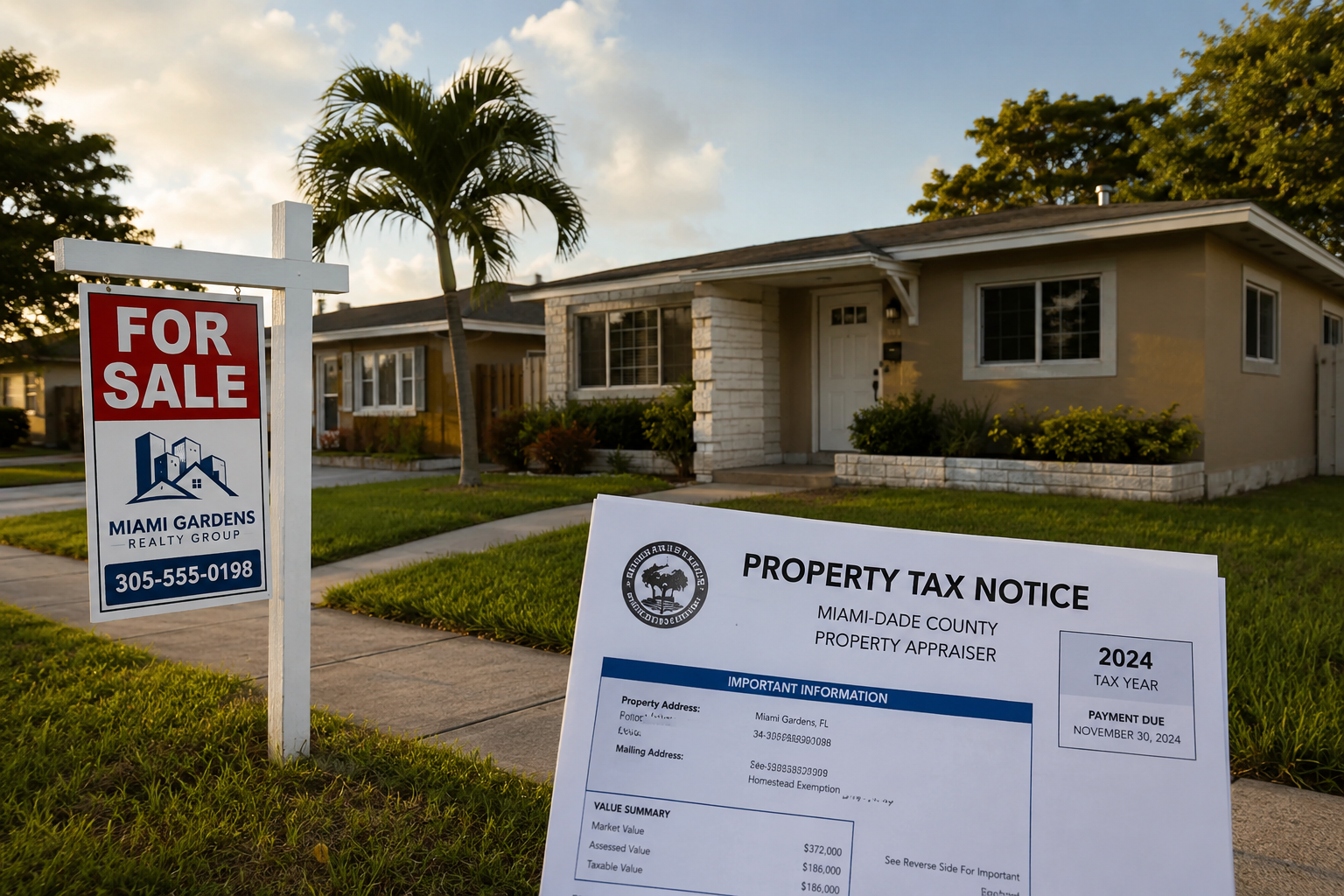
The savings are real. The risk to city services is also real. Both things are true at the same time.
Lawmakers are in Tallahassee right now, debating a proposal that could change what it costs to own a home in Miami Gardens more than anything in the city's 23-year history. Governor DeSantis called a special legislative session that began yesterday to consider a constitutional amendment titled "Save Our Homes from Excessive Property Taxes." The plan would raise Florida's homestead exemption from $50,000 to $250,000 in phases, and eventually eliminate homestead property taxes entirely for most Florida homeowners.
If you own a home in Miami Gardens and you're reading that and thinking "wait, I might not have to pay property taxes anymore?" the answer is: maybe. If the Legislature approves it (requires 60% in both chambers), if voters approve it in November (requires 60%), and if the state actually funds the trust fund it's promising to backfill local budgets, then yes, your property tax bill could eventually drop to zero.
That's the part everyone is celebrating on social media. Here's the part nobody is talking about: property taxes are how Miami Gardens pays for everything. Police. Parks. Code enforcement. Street lights. Betty T. Ferguson Recreational Complex. Rolling Oaks Park. The city services that make this a place worth living in, not just a collection of houses near a stadium. If property tax revenue disappears and the state doesn't fully replace it, those services get cut. There's no other way around that math.
This article walks through both sides: what you'd save and what you'd risk.
What the proposal actually does
| Phase | Timeline | Homestead Exemption | Effect |
|---|---|---|---|
| Current law | Now | $50,000 | First $25K exempt on all taxes; $25K-$50K exempt on non-school taxes |
| Phase 1 | January 2027 | $150,000 | Significant tax reduction for most homeowners |
| Phase 2 | 2028 | $250,000 | Eliminates property taxes for ~60% of FL homeowners |
| Goal | Legislature sets schedule | $500,000 | Would eliminate property taxes for ~92% of FL homeowners |
The exemption increase means a larger portion of your home's assessed value isn't taxed. If your home is assessed at $300,000 and the exemption is $250,000, you only pay property taxes on the remaining $50,000 of value. If the exemption reaches $500,000, a $300,000 home pays nothing.
Five important details that are easy to miss:
This is a constitutional amendment, not a law. It needs 60% approval in both the House and Senate just to get on the November ballot. Then it needs 60% of voters to pass. That's a high bar. The House passed a version in February, but the Senate blocked it over concerns about small-county budget impacts. The special session is DeSantis trying to force the issue.
New Florida residents wait 5 years. People who establish residency after the amendment passes would pay property taxes under the current system for up to five years before qualifying for the expanded exemption. DeSantis framed this as protection for existing residents and a brake on migration driven purely by the tax change.
Businesses get relief too. The proposal caps annual property tax assessment increases for businesses at 5%, down from 10%. That benefits commercial property owners in Miami Gardens, including the businesses along NW 27th Avenue.
The state promises a trust fund. DeSantis says the state will create a trust fund using its budget surplus to help local governments cover core services (public safety, education, infrastructure) during the transition. The mechanics of the trust fund would be worked out in an implementing session after the November election. In other words: the money is promised but not yet structured.
It's a phased approach, not an overnight cut. Property taxes don't disappear January 1. The exemption rises to $150,000 in 2027, then to $250,000 in 2028. Full elimination would follow a schedule the Legislature sets later. Local governments would have time to adjust. Whether that time is enough depends on whether the trust fund materializes.
What Miami Gardens homeowners would save
Miami Gardens' median home value is approximately $350,000 to $400,000. The city's combined millage rate (city, county, school board, special districts) determines the total property tax bill. Let's use a $350,000 home with a combined millage rate of approximately 20 mills (a reasonable estimate for Miami-Dade) to illustrate the impact:
| Exemption Level | Taxable Value | Estimated Annual Tax | Savings vs. Current |
|---|---|---|---|
| Current ($50K) | $300,000 | ~$6,000 | Baseline |
| Phase 1 ($150K) | $200,000 | ~$4,000 | ~$2,000/yr |
| Phase 2 ($250K) | $100,000 | ~$2,000 | ~$4,000/yr |
| Full ($500K) | $0 | $0 | ~$6,000/yr |
For a $350,000 home, the full elimination would save roughly $6,000 per year. That's $500 per month back in a household's pocket. For a family earning Miami Gardens' median income of $64,362, that's a 9.3% effective raise. At a time when gas is $4.43 per gallon and insurance premiums are still among the highest in the country, $500 a month in property tax relief is life-changing money.
For homeowners with properties valued above $400,000 (some areas of Miami Gardens, particularly near the stadium, have appreciated significantly), the savings would be even larger in dollar terms during the phased period, though they'd still pay some tax until the exemption reaches their assessed value.
What the city could lose
This is where the celebration needs a pause.
Miami Gardens, like every municipality in Florida, funds its operations primarily through property tax revenue. The city's general fund pays for police, fire services, parks and recreation, code enforcement, public works, and administration. The school board relies on property taxes for education funding. Miami-Dade County's property tax share pays for countywide services including transit, libraries, and emergency management.
The state's Revenue Estimating Conference projected the statewide impact at $4.4 billion in the first year, growing to $13.3 billion annually once the exemption reaches $250,000. That's money that currently funds city police departments, county services, school districts, and special taxing districts across all 67 Florida counties.
For Miami Gardens specifically, the impact depends on how much of the city's property tax base comes from homesteaded properties versus commercial, rental, and non-homesteaded real estate. Commercial properties, vacation rentals, investment properties, and non-homesteaded homes would still pay full property taxes. But in a predominantly residential city like Miami Gardens, homesteaded properties represent a substantial share of the tax base.
If the state trust fund doesn't fully replace the lost revenue (and "implementing session after the election" is political language for "we'll figure it out later"), city leaders face a set of choices that every resident should understand:
Cut services. Fewer police officers, reduced park hours, slower code enforcement response, deferred road maintenance. For a city about to host the World Cup and heading into an August election, service cuts would be politically devastating and practically harmful.
Raise other fees. Utility surcharges, permit fees, impact fees, stormwater fees. Cities across Florida have already begun exploring these alternatives. The NMB Water surcharge controversy showed how fee-based revenue can create its own problems.
Increase reliance on the stadium. Hard Rock Stadium and its events generate some revenue for the city through parking agreements, event fees, and indirect economic activity. But as we've reported throughout the stadium economics series, most of the billions flowing through the campus bypass Miami Gardens' tax base entirely. The stadium is a private enterprise on a county-owned site. It doesn't generate property tax revenue for the city.
What the Florida Association of Counties says
The counties are pushing back. The Florida Association of Counties' deputy executive director, Cragin Mosteller, said the proposal needs to be "grounded in real budgeting" and warned that small and mid-sized counties could face devastating impacts. Urban counties like Miami-Dade have more commercial property to absorb the hit, but the non-homesteaded commercial base alone can't replace the homesteaded residential revenue that funds core services.
The Florida League of Cities has echoed similar concerns, noting that cities like Miami Gardens that deliver direct services (police, parks, code enforcement) would face the most immediate pressure because those services are funded directly from the general fund, which is funded directly from property taxes.
How to think about this as a Miami Gardens homeowner
We're not going to tell you how to vote if this makes it to the November ballot. What we will do is lay out the framework for thinking about it honestly.
The savings are real. $2,000 to $6,000 per year is not a talking point. It's a car payment. It's a semester of community college. It's the difference between keeping your home and losing it for families who are stretched to the limit by insurance, gas, and grocery costs.
The risk to services is also real. The state is promising a trust fund but hasn't structured it. "We'll figure it out after the election" is not a fiscal plan. If the trust fund is underfunded, delayed, or tied to conditions that don't match Miami Gardens' needs, the city's budget takes the hit. And the city's budget is the police response time when you call 911, the condition of the field at Rolling Oaks Park, and the code enforcement officer who shows up when your neighbor's property becomes a problem.
The timing matters. This proposal arrives as Miami Gardens is hosting the World Cup, heading into an August city election, and navigating a summer of unprecedented event activity at the stadium. The city council that just blocked the El Dorado rezoning to protect residents needs property tax revenue to fund the services that make its votes meaningful. A council that can't fund police patrols in Venetian Gardens can't effectively enforce zoning protections either.
What happens next
The special session is underway. The Legislature will debate whether to place the amendment on the November 2026 ballot. If 60% of both chambers approve, Florida voters will decide in November. If 60% of voters approve, the exemption begins rising in January 2027.
Between now and November, expect intense debate between the governor's office (framing this as relief for overtaxed homeowners) and local government associations (warning of service cuts and budget crises). Both sides have legitimate points. The question for Miami Gardens voters is whether they trust the state to replace the revenue that makes their city function.
We'll continue covering this as the session progresses and as local impacts become clearer. If you have questions about how this affects your specific property, contact the Miami-Dade Property Appraiser's office at (305) 375-4712 or visit miamidade.gov/pa.
Frequently asked questions
Will property taxes be eliminated in Miami Gardens?
Not yet. Governor DeSantis has called a special legislative session to consider a constitutional amendment that would raise the homestead exemption from $50,000 to $250,000 (phased in by 2028), with eventual full elimination as a goal. The proposal needs 60% approval in both legislative chambers to reach the November ballot, then 60% of voters to pass. If approved, Phase 1 ($150,000 exemption) would begin in January 2027.
How much would Miami Gardens homeowners save?
A home assessed at $350,000 (near Miami Gardens' median) would save approximately $2,000 per year at the $150,000 exemption level, $4,000 per year at $250,000, and roughly $6,000 per year if the exemption eventually reaches full elimination. Savings depend on your specific assessed value and the combined millage rate applied to your property.
What happens to city services if property taxes are eliminated?
Property taxes fund police, parks, code enforcement, public works, and other city services. The governor's proposal includes a state trust fund to help local governments cover core services during the transition, but the mechanics haven't been finalized. The Revenue Estimating Conference projects the statewide impact at $4.4 billion in the first year, growing to $13.3 billion. If the trust fund doesn't fully replace lost revenue, cities could face service reductions or alternative fee increases.
Do new Florida residents qualify for the expanded exemption?
Not immediately. Under the proposal, people who establish Florida residency after the amendment passes would pay property taxes under the current system for up to five years before qualifying for the expanded exemption. This provision is designed to protect existing residents and prevent a migration surge driven solely by the tax change.
This article is informational, not tax or legal advice. Consult a tax professional for guidance specific to your property. Sources: Florida Politics, NBC 6, CBS12, yourNEWS Media, Governor's Office press release (May 27, 2026), Florida Revenue Estimating Conference. See also: cost of living guide, living in Miami Gardens, city council profile. Published: June 2, 2026.